
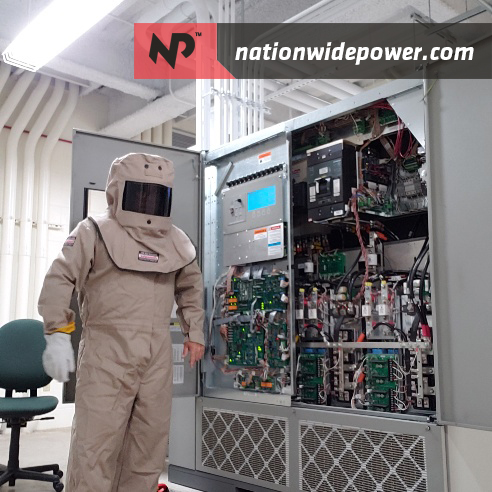
Arc flash incidents during UPS maintenance can release temperatures exceeding 35,000°F and pressure waves capable of serious injury, making NFPA 70E approach boundaries and proper personal protective equipment (PPE) mandatory for technicians working on energized systems. Understanding limited approach (42 inches for 480V systems), restricted approach (12 inches), and arc flash boundaries—along with proper lockout/tagout procedures—is essential for preventing electrical injuries in critical power environments.
Arc flash incidents represent one of the most dangerous hazards that Critical Power Professionals™ face in their daily work. Understanding arc flash and approach boundaries is essential for protecting workers from severe injuries or fatalities when working with energized electrical equipment. The National Fire Protection Association (NFPA) 70E standard provides comprehensive guidelines that establish critical safety zones around energized conductors.
An arc flash refers to an electrical explosion that releases intense energy when electricity arcs through the air between conductors or from a conductor to the ground. These incidents produce temperatures that often exceed 35,000°F. The explosive release of energy vaporizes metal conductors, producing high pressures and projectiles that can cause severe burns, ignite clothing, and result in fatal injuries.
The critical approach boundaries form the foundation of electrical workplace safety, protecting workers from arc flash and shock hazards. Learn more about the three distinct safety zones established by the NFPA and understand how they create comprehensive protection zones for those working on or near energized electrical equipment.

The limited approach boundary marks the distance where an electric shock hazard exists. Unqualified workers may only cross this boundary when supervised by a qualified electrician. This boundary varies based on system voltage and equipment configuration, making proper assessment critical for arc flash safety requirements.
The restricted approach boundary represents the highest likelihood of electric shock. Only qualified professionals wearing appropriate personal protective equipment (PPE) may enter this zone. Under no circumstances should unqualified workers cross the restricted approach boundary. Often, this is the sole reasoning behind our Critical Power Professionals™ asking our customers to honor this distance during maintenance or repair efforts.
The arc flash boundary defines the distance where a worker without appropriate arc-rated PPE could receive second-degree burns from an arc flash incident. This boundary is independent of shock protection boundaries and may be located inside or outside the limited and restricted approach boundary zones. NFPA 70E sets this boundary at the point where incident energy equals 1.2 cal/cm².
Much like the Restricted Approach Boundary, this is also an area where we request that our customers honor this distance during maintenance or repair efforts.
NFPA 70E establishes comprehensive safety requirements that workers must follow when working on or near energized electrical equipment:
The NFPA 70E standard provides the framework for electrical safety in the workplace, establishing requirements that protect workers from arc flash and shock hazards. Employers must ensure their teams understand the relationship between approach boundaries and arc flash hazards. The restricted approach boundary and the limited approach boundary protect against shock, while the arc flash boundary specifically addresses thermal hazards.
At Nationwide Power, our Critical Power Professionals™ receive comprehensive training on NFPA 70E requirements and arc flash safety protocols. We prioritize creating electrically safe work conditions whenever possible and follow strict procedures when energized work is necessary. Request a quote for our critical power services, which help meet stringent safety requirements and significantly reduce the risk of arc flash incidents.
Written By:
David Paiz
Training and Technical Support Manager
Environmental, Health, and Safety