
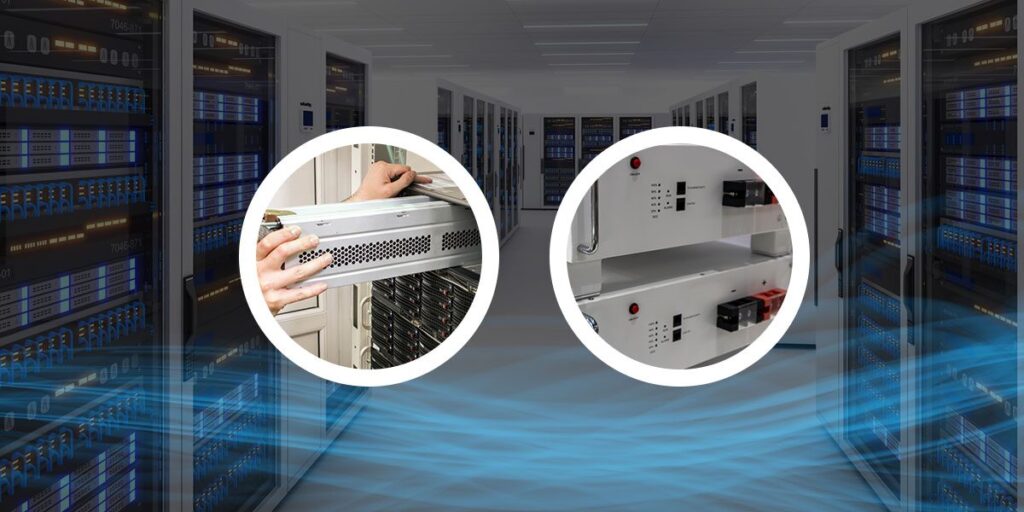
Emergency lighting inverters and UPS systems both provide backup power during outages but serve different purposes: inverters are code-compliant solutions specifically designed for NFPA 101 emergency egress lighting with 90-minute minimum runtime, while UPS systems support broader critical loads including IT equipment, medical devices, and industrial controls. Emergency lighting inverters typically cost less and focus solely on life safety applications, whereas UPS systems offer comprehensive power protection with runtime based on battery capacity and connected load.
Imagine your facility loses power. Server room lights flicker, but the hum of the cooling fans and the blink of the server racks continue without a hitch. In the hallway, the main lighting shuts off, but the emergency exit signs and egress lighting instantly glow to life, guiding people to safety. Both the server room and your emergency lighting maintained power, but the technology used for each is radically different. So, what are those differences between the UPS system and emergency lighting inverters?
Both systems rely on batteries to provide backup power, but they have different missions. One protects your data while the other protects people. Confusing the two can lead to code violations, failed inspections, or damaged equipment.
Learn to confidently distinguish between a UPS and an emergency lighting inverter, ensure your facility meets critical life-safety and electrical codes, and choose the right backup system to protect your specific assets.
The goal of an uninterruptible power supply (UPS) is business continuity and data protection. A UPS is designed to provide clean, uninterrupted, computer-grade power to equipment that cannot tolerate even a millisecond of downtime.
A true online double-conversion UPS does more than wait around for a blackout. It conditions incoming alternating current (AC) utility power, which often experiences total harmonic distortion (THD), voltage transients, or instability.
A UPS converts power back to a perfect AC sine wave. It accomplishes this by first converting the unstable AC power to clean direct current (DC), and then using that DC power to generate a brand-new, perfectly stable AC sine wave at the output.
This stable output protects your equipment against power surges, sags, frequency variations, and line noise. Crucially, the transfer time to battery power is zero. As the load continuously runs off the inverter, there is no mechanical switchover delay that could crash a server.
Most online UPS systems include an internal static bypass. This failsafe can instantly transfer the load back to utility feed if the UPS experiences an internal problem, ensuring critical equipment continues to run even if the UPS itself requires service.
You will find UPS systems guarding critical electronic loads, like:
If the load is a computer or a microprocessor that needs “clean” power to function, it belongs on a UPS.

The primary goal of an emergency lighting inverter (ELI) is life safety. Having an ELI also means mandatory, logged testing, like the 30-second monthly and 90-minute annual tests required by the NFPA 101 Life Safety Code®.
An ELI’s sole purpose is to keep designated emergency and exit lights illuminated during a power failure so occupants can safely evacuate a building.
Unlike a UPS, most emergency lighting inverters operate as standby systems. They monitor the utility power and, when a failure is detected, switch the load to battery power.
The transfer time is typically a few milliseconds, which is perfectly fine for a light bulb. The human eye won’t even notice the blink. However, the power output is often not as strictly conditioned as a UPS. Lighting is more rugged, creating a simple resistive or linear load that will not crash or lose data if the voltage wave isn’t perfect for a fraction of a second.
Additionally, an ELI is specifically designed to handle the massive inrush current that occurs when a large bank of lights turns on simultaneously. A standard UPS might not support this sudden surge and shut down and/or attempt a transfer offline. However, an ELI is designed to manage this surge, adding to its reliability for lighting-specific loads.
Lighting inverters are the unsung heroes of building safety, powering:
These systems are required in most commercial buildings, including schools, offices, banks, and manufacturing facilities. They are governed by strict life-safety codes that prioritize reliability and runtime over power purity.
Now that we have defined the roles of UPSs and ELIs, let’s break down the specific technical and regulatory differences between UPS and inverter systems.
The most significant difference lies in the testing and certification. You cannot simply swap one for the other and pass a fire marshal inspection.
When comparing UPS systems vs. emergency lighting inverters, the quality of power matters.
UPS systems deliver a pure sine wave output with zero transfer time, which is nonnegotiable for servers. If you plug a server into a standby lighting inverter, the millisecond gap during the transfer might cause the server to reboot or corrupt data.
The output of lighting inverters is designed for linear lighting loads. The transfer time is fast enough to keep a room lit, but that brief interruption is an eternity in the world of microprocessors.
The internal components of these two systems are designed to withstand different types of stress. Computer power supplies draw power in pulses, which can create harmonic distortion. A UPS is built to handle this complex demand from nonlinear loads.
When an LED or incandescent light turns on, it may create a spike of power for a split second. An emergency lighting inverter is built to absorb this. A standard UPS might interpret that inrush spike as a short circuit and shut itself down to protect itself, leaving you in the dark.

Understanding the differences between UPS systems and emergency lighting inverters is the first step. The next step is ensuring your facility is both protected and compliant. Managing two different types of critical power systems can be a headache, but it doesn’t have to be.
Nationwide Power offers a unique advantage — we are experts in both. We understand that your data center UPS requires delicate and precise maintenance to protect your uptime, while your ELI requires rigorous testing to meet NFPA 101 life-safety codes.
We act as a single-source partner for all your critical power needs. Our Critical Power Professionals™ have the expertise to service, maintain, and repair both systems, preventing compliance issues before they become liabilities.
Explore our UPS services to safeguard your IT infrastructure or learn more about our services for emergency lighting inverters to ensure life safety compliance.
Ready to ensure your facility has the right protection for every application? Request a quote for a comprehensive assessment of your backup power systems or speak with a Nationwide Power representative today.