

Large enterprises typically require modular, scalable UPS systems with N+1 or 2N redundancy configurations, capacity ranges of 100-800 kVA, and hot-swappable components to ensure zero downtime during maintenance. Three-phase double-conversion online UPS systems from manufacturers like APC, Eaton, and Vertiv are the industry standard for data centers, hospitals, and financial institutions where power reliability is mission-critical.
Unplanned business outages due to power failure can have drastic downstream effects. One 2024 study revealed that downtime costs Global 2000 companies a total of $400 billion annually. It also found 44% of interruptions stem from infrastructure issues, including power failures.
Regardless of company size, no one can afford surprise shutdowns. That’s why having an instant backup power device called an uninterruptible power supply is nonnegotiable. Here’s how to select the best UPS for your business.
The true cost of a power failure extends far beyond lost revenue. Direct expenses — like overtime wages, regulatory fines, and disrupted operations — are easy to quantify. Indirect impacts, such as data loss or damage to your brand reputation, are harder to measure but often carry even more significant long‑term consequences.
Here are a few examples of potential power failure consequences, as stated by Oxford Economics’ global report:
The financial repercussions span from revenue and operations to reputational damage and legal fees. High-capacity enterprise UPS systems provide companies with continuous power, preventing adverse outcomes.
Large enterprises face more complex power challenges than smaller ones due to their scale and critical infrastructure. To achieve the near-zero downtime they require, they should invest in business continuity power systems with features and functions that can handle their demands.
Additionally, you must understand your electrical infrastructure, especially if you have a large facility. Knowing this will further guide your decision-making process and ensure the system aligns with your enterprise’s needs in terms of compatibility, performance, cost, and safety.
Choosing a UPS for your business starts with assessing your operational needs. The “best” system isn’t universal — it depends on your equipment, budget, uptime requirements, and the daily conditions at your facility.
In no particular order, here are the foremost UPS types and applications. We’ll also highlight leading manufacturers to consider as you evaluate your options.
Uninterrupted power is an absolute must in these environments. IT infrastructure requires high-capacity, highly reliable UPS systems with additional features, including three-phase power for stability, double-conversion topology for power delivery, and N+1 or 2N redundancy to guarantee failover protection. Scalability is another attribute to consider. The UPS must be able to grow with your enterprise.
Manufacturers such as APC by Schneider Electric, Mitsubishi, and Vertiv lead the way in this space.
Health care facilities rely heavily on continuous power to serve patients and operate sensitive medical equipment, necessitating exceptionally reliable UPS systems. The medical industry also uses three-phase power and double-conversion topology to actively eliminate power irregularities. Beyond a UPSs core functionality, it should provide an optimal balance between performance and energy efficiency to ensure a continuous, stable supply.
Manufacturers like Eaton and Riello are well-regarded for providing dependable solutions tailored to the demanding and sensitive requirements.
Durable, precise UPS systems are a priority when using heavy machinery in demanding conditions. Consistent three-phase power is often a prerequisite, as is built-in bypass functionality that allows you to perform maintenance without disrupting critical operations. Ultra-reliability is the focus here.
Companies like Mitsubishi and Toshiba offer rugged and high-capacity UPS systems specifically engineered for critical needs and complex electrical requirements.
Commercial buildings need UPS solutions that seamlessly integrate into their existing IT environments. Their dynamic nature benefits from commercial UPS solutions that offer advanced monitoring capabilities, rapid deployment, and hot-swappable modules for scalability and maintenance.
Vertiv and APC by Schneider Electric are particularly effective in these applications. They deliver essential flexibility and power management for business continuity.
The TCO of UPS systems involves up-front capital expenditure for the hardware and its installation. Thereafter, your business will incur long-term operating expenses, including the system’s energy consumption, maintenance, cooling, upgrades, and eventual replacements. Capital expenditures typically make up 30% of ownership costs, whereas operating expenses generally account for 70%.
Upkeep is the most crucial operating expense. Skipping preventive maintenance is far too risky, as it can result in costly emergency services and potential business downtime while you wait for technicians to repair or replace it. The ensuing delay will also defeat the UPS system’s primary purpose of maintaining continuous operations.
The typical life cycle of a valve-regulated lead-acid battery in a UPS is between 3 and 5 years. However, look for signs that it’s time to replace a UPS battery, such as warning lights, visible damage, an unreliable power supply, inconsistent voltage readings, and the system’s age.
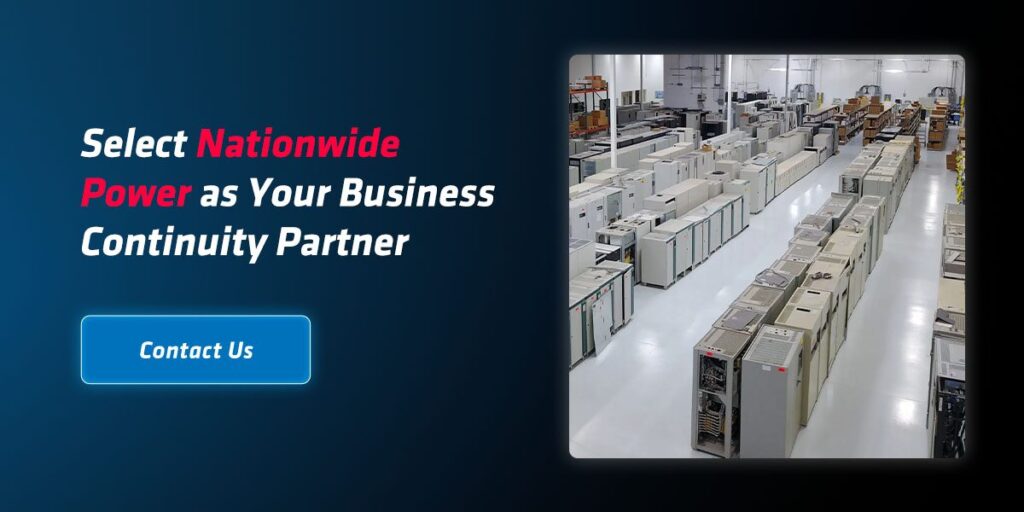
Since every large enterprise operates differently, your chosen UPS system should align with your specific needs and uptime expectations. With so many large business power backup options available, weighing the pros and cons can feel overwhelming — but doing your research will simplify the decision.
Nationwide Power is a multibrand UPS provider that offers vendor-neutral consulting and other UPS-related services. Let our highly trained Critical Power Professionals™ use their decades of experience to help you select the ideal system for your specific infrastructure.
Complete our contact form or call us at 800-868-2780 to request a site audit or TCO analysis.