
Designing scalable power infrastructure for growing organizations means building systems that scale with actual load growth rather than forcing expensive retrofits when capacity hits its ceiling. Modular uninterruptible power supply (UPS) architecture solves this by allowing you to add power modules incrementally as requirements grow, keeping up-front costs proportional to current needs while maintaining a clear path for expansion.
Organizations that plan for growth from day one avoid both the capital waste of over-provisioning and the operational risk of running systems at their limits.
Modular UPS architecture represents the foundational design decision because it determines whether your infrastructure scales gracefully or forces a rip-and-replace down the road.
Monolithic UPS designs deliver power through a single large unit sized for a fixed load. Organizations that outgrow a monolithic system often must replace the entire unit, which creates expensive downtime and leaves stranded capacity if they overbuilt initially.
Engineers build modular systems from independent, hot-swappable power modules within a shared frame or cabinet, so you can add a new module as capacity grows while reducing the need for shutdowns or major infrastructure replacement. This modular construction approach to expandable UPS infrastructure minimizes the rip-and-replace scenario and enables a pay-as-you-grow model.
Four key features make a modular UPS genuinely scalable:
These features create infrastructure scalability that adapts to real-world demand, which is why data center UPS systems can rely on modular architecture.
Power capacity planning helps ensure infrastructure can meet future demands, not just today’s requirements. Assess your current and projected needs, then implement capacity in phases.
Start your load assessment by measuring current IT load at the rack, row, and room levels, then project forward based on business growth plans. Organizations that skip this step may discover their actual load patterns differ significantly from initial assumptions.
Building in meaningful headroom beyond your projected end-state protects against growth that outpaces forecasts. This buffer becomes increasingly important as data center energy demands grow 13%-27% annually through 2028, so organizations can’t afford to plan only for today. Concern about forecasting future capacity requirements has grown by 9% among operators since 2023, making accurate load assessment more critical than ever.
UPS design consultation services can help organizations nail down those projections before committing capital.
Phased construction means you design the mechanical, electrical, and plumbing (MEP) backbone for the full end-state from day one, but you only deploy and energize UPS capacity in phases as actual load grows. Oversize cable pathways and reserve floor space now, then activate capacity when utilization hits defined thresholds.
Each phase becomes operational before the next begins:
This approach helps eliminate stranded capital while preserving the ability to scale and works hand in hand with modular UPS architecture. Design and site survey services can help you map out a phased implementation plan that matches your growth trajectory and keeps scalable power infrastructure aligned with business needs.
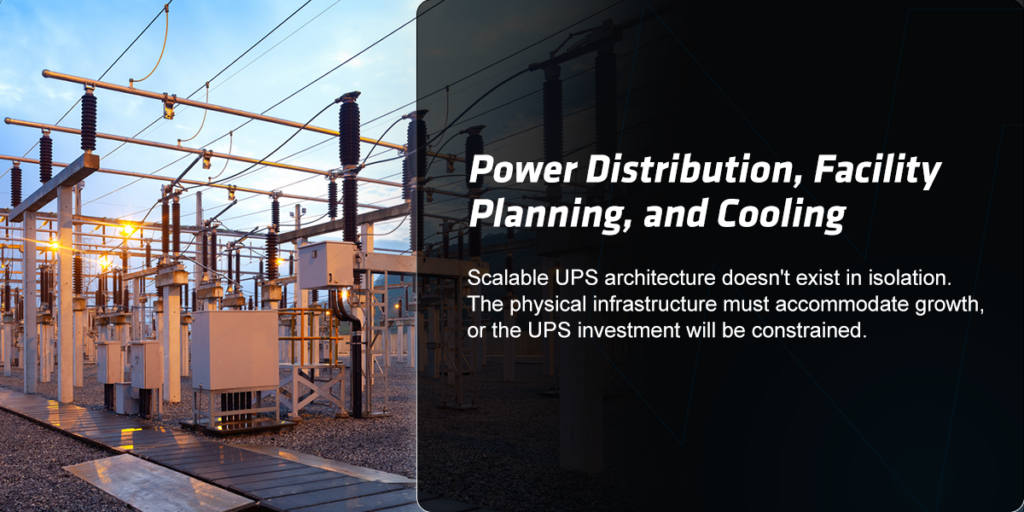
Scalable UPS architecture doesn’t exist in isolation. The physical infrastructure must accommodate growth, or the UPS investment will be constrained.
Three primary redundancy models govern how systems handle failures:
Match redundancy to actual business risk tolerance and uptime requirements because defaulting to the cheapest option without understanding what a failure costs represents a common mistake. The Uptime Institute Tier classification framework (Tier I through IV) provides a recognized benchmark for comparing redundancy levels.
Power issues cause 45% of impactful outages, and UPS failures account for 42% of power-related outages, underscoring the importance of choosing the right redundancy level.
Design the MEP backbone for the end-state, even if full build-out is years away. Reserve floor space and oversize cable trays, busways, and conduit runs now, which means future capacity additions won’t require tearing out existing infrastructure.
Cooling and ventilation must scale with UPS capacity because load growth increases heat output in proportion. An undersized cooling system will bottleneck a well-designed UPS installation, so ensure your HVAC infrastructure can handle end-state thermal loads.
Modular architecture delivers scalability when you plan budget phasing, verify compatibility, and track component life cycles.
Modular architecture shifts capital deployment from a large up-front expense to a phased investment aligned with load growth. Day-one capital expenditure drops because capacity gets added only when load justifies it, which means organizations avoid tying up cash in unused infrastructure while maintaining a clear expansion path.
This approach becomes financially justifiable because spending is directly tied to business needs rather than speculation about future demand.
When you expand a modular system, new modules must work with existing infrastructure, including battery chemistry, communication protocols, and switchgear.
Working with a multi-brand, vendor-neutral provider helps ensure compatibility across makes and models before committing to expansion, protecting the investment you’ve already made. Data center UPS systems particularly benefit from this vendor-neutral approach because technology evolves quickly, and locking into one manufacturer’s roadmap limits your options.
UPS systems typically operate for 10–15 years, so a phased migration to modular architecture allows capacity transfers without full-facility shutdowns. Hot-swappable modules enable maintenance and upgrades without service interruption, keeping modular UPS systems running throughout the transition.
Component replacement follows its own schedule, separate from system-level upgrades. Valve-regulated lead-acid (VRLA) batteries carry a three- to five-year useful service life, capacitors need replacement every five to seven years, and tracking these timelines separately prevents failures that come from running components beyond their design life.
Nationwide Power serves as the end-to-end partner for organizations ready to build or expand their power infrastructure, from initial design consultation and site survey through equipment selection, implementation, and long-term maintenance. Critical Power Professionals™ average 22+ years of experience and draw from a $10 million+ parts inventory to deliver solutions tailored to your actual load requirements and growth trajectory.
Multi-brand, vendor-neutral consulting means that recommendations focus on your needs, not on one manufacturer’s catalog, while strong original equipment manufacturer (OEM) relationships help pass savings on to customers. When systems demand it, 24/7 emergency service provides the backup you need.
Contact Nationwide Power to learn how you can meet your growing business power needs.