
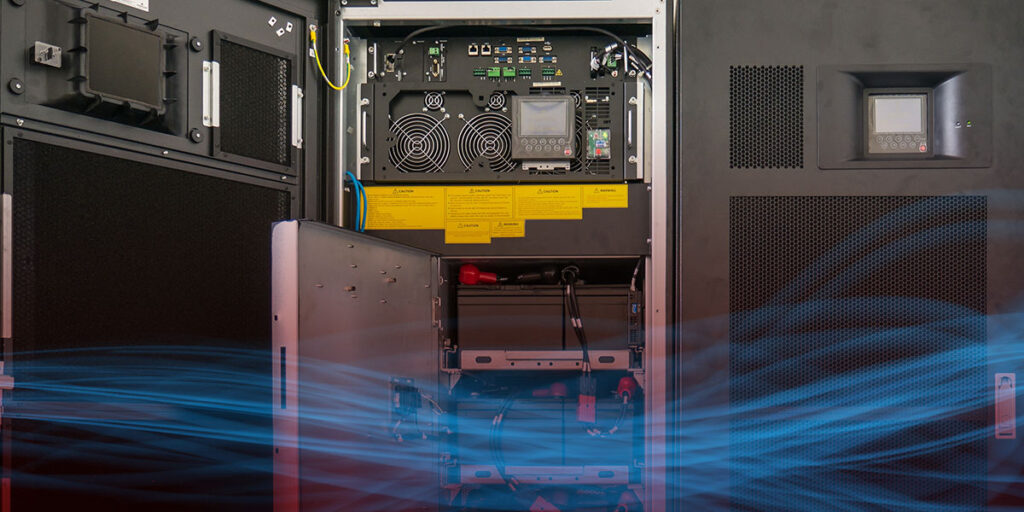
Picture a scheduled preventive maintenance (PM) visit catching weak battery cells three months before a weekend power event. The Critical Power Professional™ spots elevated temperature readings, tests string voltage, and schedules replacement during your next maintenance window. Later, when utility power drops, your uninterruptible power supply (UPS) is better positioned to support the connected load, preserve battery run-time, and help keep your team out of emergency-response mode.
Preventive maintenance gives facility teams control over UPS system reliability through scheduled inspections and component replacement on a planned timeline. Reactive service responds only after equipment fails or after the load drops. The cost analysis between these approaches compares predictable expenses against emergency repair exposure and downtime consequences.
A UPS power outage can result in six- or seven-figure costs when downtime affects operations, data, revenue, or safety. More than half of operators reported their most recent outage cost more than $100,000, with one in five exceeding $1 million.
Unplanned downtime can cost small and midsize enterprises up to $150,000 per hour in some industries. More than 90% of large firms lose $300,000 or more per hour during outages. The business case starts with outage consequences rather than maintenance price.
A real-world example illustrates these principles in a UPS-specific context. One client reduced their service agreement level in a bid to save about $1,500. Over the following six months, that decision resulted in $29,000 in emergency repair costs, expenses a full-service agreement would have covered.
Proactive maintenance makes UPS systems less susceptible to component aging while reducing the likelihood that a serviceable unit will require early replacement. A scheduled inspection can identify conditions so you can get them fixed before they become bigger problems.
Through regular PM, your facility team gains protection against data loss, compliance exposure, and unpredictable expenses that strain operating budgets. For UPS systems supporting emergency and standby power, the National Fire Protection Association (NFPA) 110 requires:
A proactive maintenance program produces the documentation trail that satisfies these requirements while creating audit-ready records.
In one deferred maintenance case, a client postponed PM visits and ignored an original equipment manufacturer (OEM) recall notice. Capacitor failure damaged their equipment and forced the UPS into bypass mode with the critical load at risk, outcomes that regular service could have prevented.
Of all components in a UPS system, battery health delivers the most immediate, measurable value through scheduled maintenance. Regular battery maintenance protects system reliability because batteries age without obvious symptoms, and weak cells can limit the entire string’s usable battery run-time. Valve-regulated lead-acid (VRLA) batteries need replacement every three to five years.
Early evidence that you might need to start planning replacement includes:
Proper battery maintenance catches these factors before they affect operations. In the Liebert AP367 case study, the customer delayed recommended battery, fan, and capacitor work. Within 60 days, the batteries failed and dropped the load, creating an emergency that could’ve been transformed by scheduled service into a planned replacement on a maintenance timeline.
A professional battery inspection verifies whether the battery system can support the connected load when called upon. The process can include:
Written findings help teams decide which battery work belongs in the next budget cycle, turning invisible risk into scheduled service items. Any problems identified during inspection get addressed on a timeline, while problems identified after a failure get addressed in a crisis.
Proactive UPS maintenance gives leadership three distinct decision points — cost control, system oversight, and service accountability. Each one is backed by evidence that translates data into budget-ready language.
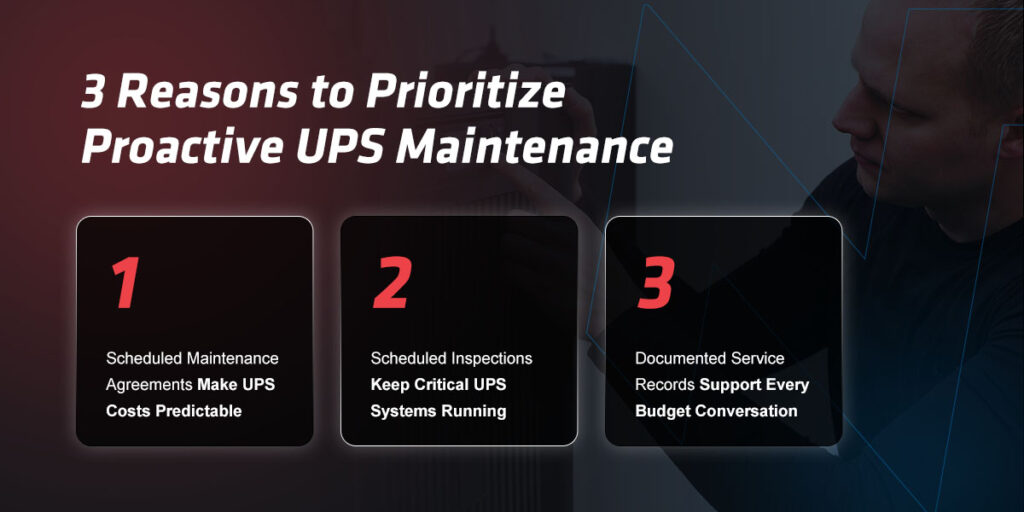
Scheduled maintenance agreements convert unknown repair exposure into a planned operating expense that finance teams can model, budget, and approve in advance.
Real-world outcomes support these findings. In the Schneider Electric case, a customer ended up paying significantly more than the cost of their full-service maintenance plan when their system went down. The full-service agreement would have covered those repair costs, making the finance argument clear. UPS maintenance cost savings emerge from predictable expenses that prevent larger emergency bills.
Scheduled inspections give trained professionals a structured view of operating conditions by evaluating batteries, switches, fans, breakers, voltage, temperature, and vibration indicators. A Critical Power Professional™ can assess ventilation, cleanliness, and connection integrity on a regular cadence. Technical review gives facility teams a current picture of the system’s condition rather than relying on age, alarms, or assumptions about equipment health.
Inspections can help identify potential causes of UPS failures before they escalate into outages. Scheduled inspections can help to address conditions that, if left unaddressed, could lead to reliability issues. Preventive maintenance for UPS systems includes a feedback loop that keeps systems operational through early intervention.
Documented service records give leadership written proof of UPS oversight and system care. Full-service PM agreements produce service reports, baseline readings, battery test results, and replacement recommendations, creating an evidence trail.
NFPA 110 inspection and testing expectations make written records valuable for compliance and audit readiness. When leadership asks what protects the system, documentation gives the answer in writing with dates, findings, and signatures that satisfy internal and external review requirements.
Service agreements vary, so teams should compare coverage by response access, equipment scope, and service depth before selecting a program. They might include:
A UPS system should receive preventive maintenance at least once per year. Critical-load systems supporting high-value equipment or operations get the best UPS preventive maintenance benefits with semiannual visits. NFPA 110 also calls for ongoing PM through weekly inspections, monthly exercises, and testing at least every 36 months, so PM is a scheduled program rather than a single appointment.
Investing in UPSs help you plan ahead and keep your operations running even during unforeseen outages. With the right partner to handle preventive maintenance, your business can maintain productivity and revenue.
The Critical Power Professionals™ at Nationwide Power average 22 years of field experience servicing nearly any UPS make, model, or age. A customized PM agreement puts that expertise on your schedule with semi-annual visits, battery testing, thermal imaging, performance evaluations, and 24/7 emergency support backing your system around the clock.
Contact one of our live representatives or call us at 800-868-2780 to build a UPS maintenance plan that supports your facility’s critical power priorities.