When utility power drops at a hospital, operating rooms stay lit, and ventilators keep running. When a data center loses its grid connection, servers continue running without a noticeable dip.
Both scenarios depend on backup power. The type of backup power system varies based on how fast it needs to start, how long it can sustain the load, and whether the power arrives conditioned or raw.
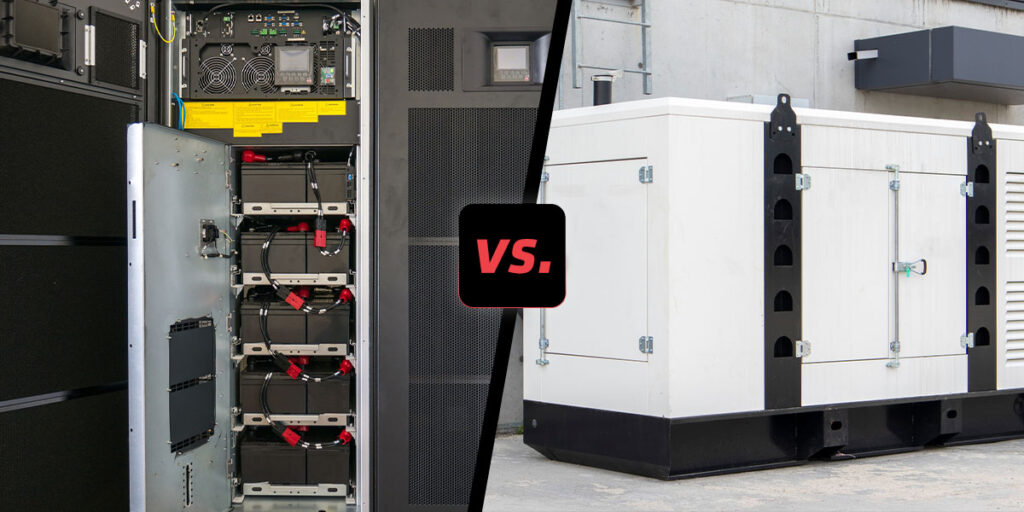
An uninterruptible power supply (UPS) provides instant, conditioned power to loads that can’t afford a power loss. A generator provides longer-duration backup. Response time, battery runtime needs, load criticality, and maintenance capacity all factor into the right setup.
These systems differ in how fast they restore power, how long they support the load, and whether they condition the power. Each commercial backup power option serves a different purpose.
The UPS activates within milliseconds of a power failure, so connected equipment keeps running during the outage. Besides activating almost immediately, UPS systems regulate voltage and stabilize frequency. Clean power delivery is vital for servers, IT networks, medical equipment, and telecom systems.
Typical commercial battery runtime varies based on the size of the battery, the conditions in which it’s being used, and the load it’s under. Facilities that need longer-term protection can add extra battery strings, which will extend the time they can run on battery power. The correct UPS battery sizing and maintenance should be documented, from selection and testing to replacement protocols, so you know the system will perform when needed.
A generator provides longer-duration backup once the unit starts and reaches a stable output. Generator-backed emergency power may restore power within 10, 60, or 120 seconds, depending on the system classification and application. Emergency systems in life-critical spaces like hospitals must activate within 10 seconds of power loss.
Runtime comes down to fuel supply. As long as you have fuel, the generator can run from hours to days, although maintenance, ambient conditions, and mechanical reliability also play a role.
Generators don’t condition power the way a UPS does. Voltage can fluctuate during load pickup, which is why sensitive equipment benefits more from UPS conditioning than from being connected directly to generator power.
Generators work for whole-building backup and long-duration outages where fuel supply and mechanical reliability matter more than how quickly the backup power starts.
UPS systems and generators solve different parts of the same backup power problem. When utility power goes down, the UPS activates immediately to keep the critical load running without disruption. The generator starts during the transition window, which is the time after the power loss.
Once the voltage and frequency stabilize, the generator assumes the role of the utility power source while the UPS recharges its batteries and continues to support the load and/or returns to standby protection.
With data center outages costing significant time and money, a backup power system is a valuable investment to keep business running as usual. Regular UPS maintenance and services keep the combined system performing for years to come, protecting both your uptime and revenue.
The right backup power setup depends on load criticality, runtime requirements, and life cycle cost.
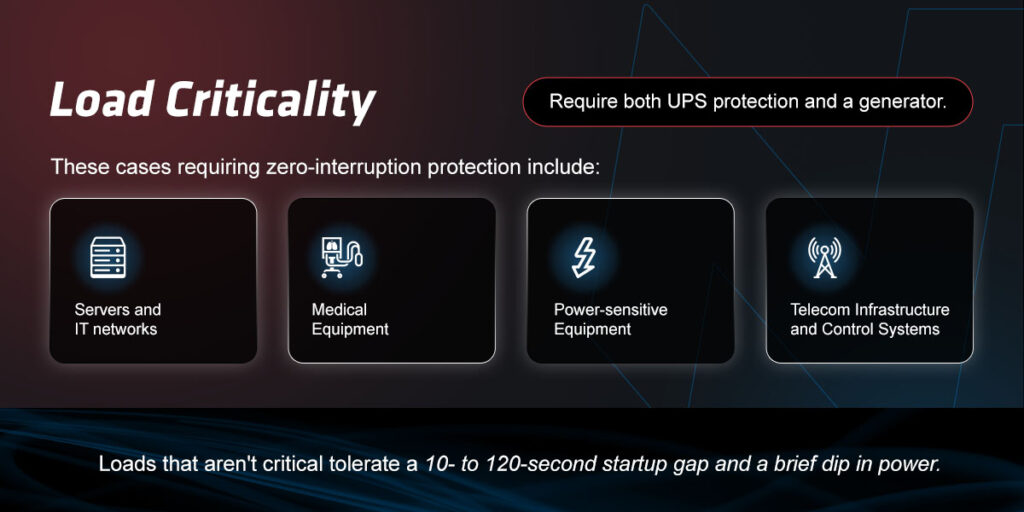
Operations that are considered critical need both UPS protection and a generator. These cases requiring zero-interruption protection include:
Loads that aren’t critical tolerate a 10- to 120-second startup gap and a brief dip in power. Heating, ventilation, air conditioning, general lighting, and many manufacturing lines fall into the medium-criticality category. Having a UPS is still worthwhile if you’d prefer uninterrupted power.
The runtime you need determines whether a generator will be enough or if you need UPS backup too. UPS battery runtime is typically short and designed to bridge the gap between the power failure and the generator starting. Generators are built to handle longer outages once they’re up and running.
Extended UPS power beyond a few minutes is possible, but adding more power can become expensive and take up space. A generator covers you for hours-long outages, and if you need consistent power without even a couple of minutes of downtime, add a UPS.
Total cost of ownership matters more than up-front equipment price alone. The cost over the lifetime of the UPS and generator system includes:
Investing in preventive UPS maintenance services helps you control costs by identifying battery, component, and performance issues early. A proactive maintenance agreement turns unpredictable repair needs into a planned operating expense, so you can better estimate the total cost of ownership over time.
Data centers need UPSs and generators because servers, storage, networks, and cooling require continuous power with zero transfer time. Double-conversion UPS topology is the standard for data centers because it delivers three critical functions:
Once the UPS bridges the startup gap, the generator serves as the primary utility replacement for hours or days.
Hospitals are required to have backup power in accordance with the National Electrical Code (NEC), or the National Fire Protection Association (NFPA) 70, which requires two independent power sources. The NFPA 99 healthcare code classifies healthcare spaces by risk level and sets requirements for essential electrical systems based on the impact on patient safety.
Category 1 areas demand the highest level of power protection:
Life safety and critical branches require power restoration within 10 seconds of losing power. Emergency generators are designed with this requirement in mind, but a UPS system adds an extra layer of security to prevent disruption.
Effective maintenance starts with regular professional checks. Keeping your UPS in good condition includes:
Generators also need regular checks, including:
Nationwide Power supports facilities that need practical guidance on UPS equipment, battery runtime, and long-term backup power planning. We supply multi-brand UPS equipment, including new, surplus, refurbished, and legacy systems that original equipment manufacturers have discontinued.
Beyond equipment, Nationwide Power supports battery replacement, performance evaluations, inspections, and maintenance agreements. Our Critical Power Professionals™ average 22 years of experience, and our extensive parts inventory supports faster access to replacement parts.
Call us at 800-868-2780 and speak to one of our professionals, send us an email, or request a quote online to start taking control of your backup power solutions.