
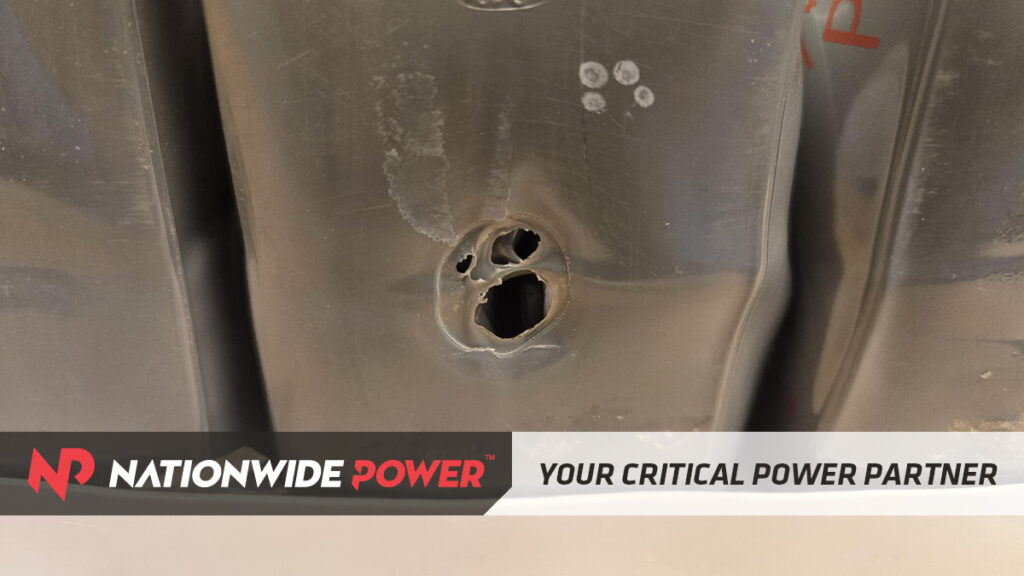
Thermal runaway battery events rarely start with obvious alarms. Sometimes, the first sign is something as subtle as a smell. In this case, that early signal enabled swift action and a controlled outcome.
This Nationwide Power™ (NP™) case study highlights how experienced diagnostics and a proactive response contained a serious battery failure without disrupting operations.
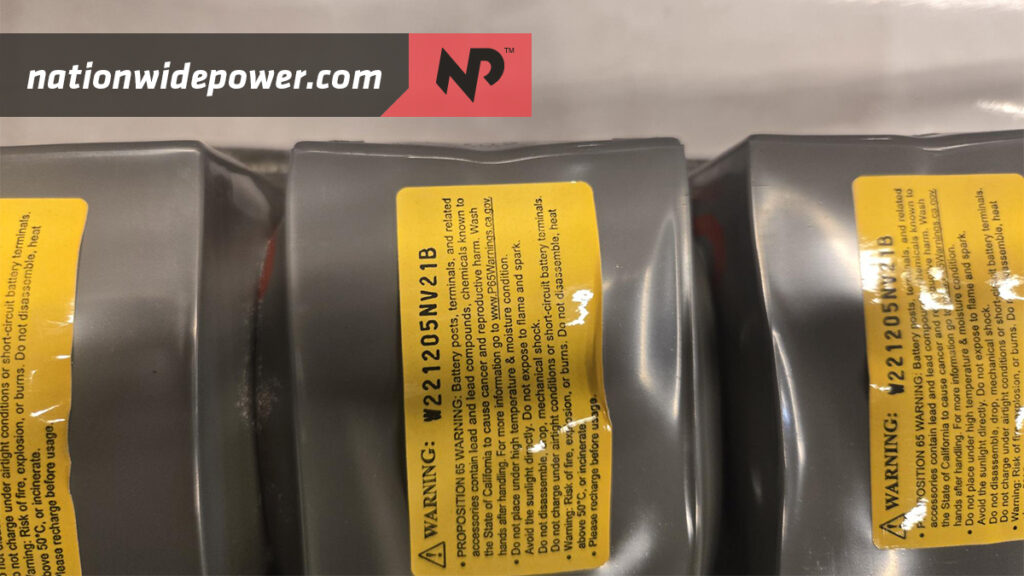
| Product | Eaton Powerware 9355 30kVA with CSB HR1234WF2FR batteries |
| Application | Industrial Manufacturing |
| Synopsis | The customer’s on-site team contacted Nationwide Power after noticing an unusual smell near the uninterruptible power supply (UPS). No alarms or fault codes were reported. The unit was already on bypass, and fortunately the load was not lost, as the other two parallel units continued to support the facility. It was also under a full-service contract with regular preventive maintenance. |
| Preliminary Actions | A Critical Power Professional™ (CPP™) was sent to investigate the issue. Initial testing of the I/O board and battery voltage levels showed no obvious faults. Due to the reported smell, the CPP opened and inspected the battery packs, during which several batteries were found to have overheated during the previous recharge cycle, resulting in thermal runaway. |
| Resolution | The CPP determined the unit was unsafe to operate and left it offline to prevent fire or further damage. Because of the parallel system, the client’s critical load remained secure and supported by the other two UPSs. Nationwide Power prepared a quote for 324 replacement batteries and responded swiftly to meet the client’s urgent replacement request. NP’s technical expertise and clear communication ensured a smooth and efficient process.Configuring systems with parallel UPS units gives sites an additional layer of reliability. As a result, the customer experienced a seamless transition and uninterrupted uptime throughout the incident. Such redundancy is critical for industrial manufacturing environments, where even brief outages can have significant operational consequences. |
| Root Cause | The batteries, installed in June 2023 and manufactured just six months earlier, failed less than two years into service. The investigation revealed that a previous power failure had drained the batteries to approximately 9.8 volts per unit. During recharge, the weakened cells experienced stress, leading to a cascading failure within the battery string. This triggered thermal runaway. This incident highlights that even with regular maintenance, component end-of-life can present serious risks that require an expert response. |
| Further Reading | UPS Battery Thermal Runaway Prevention Top-Tier UPS Battery Services Case Study #106 Thermal Runaway |
Nationwide Power provides preventive maintenance services to identify overheating issues before they lead to costly downtime. With 24/7 support and nationwide service capabilities, we help keep your critical power infrastructure operational. Request a quote today for expert maintenance and battery system support.